(9,861 - 9,880 of 10,079)
Pages
-
-
Title
-
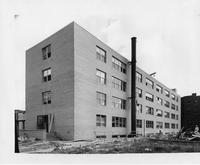
Farr Hall under construction, Illinois Institute of Technology, Chicago, Ill., 1948
-
Date
-
1948
-
Description
-
Photograph of Farr Hall under construction in 1948. Farr Hall is located at 3300 South Michigan Avenue, Chicago, Ill. It was designed by the...
Show morePhotograph of Farr Hall under construction in 1948. Farr Hall is located at 3300 South Michigan Avenue, Chicago, Ill. It was designed by the firm Skidmore, Owings & Merrill and was constructed in 1948. Farr Hall was also known as Student Service Building beginning in 1977. Photographer unknown.
Show less
-
Collection
-
Office of Communications and Marketing photographs, 1905-1999
-
-
Title
-
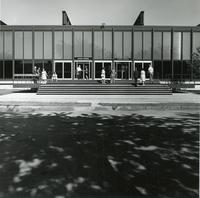
Grover M. Hermann Hall, Illinois Institute of Technology, Chicago, Ill.
-
Date
-
1962-1969
-
Description
-
Photograph of Hermann Hall, located at 3241 South Federal Street. Grover M. Hermann Hall was designed by Walter Netsch of Skidmore, Owings &...
Show morePhotograph of Hermann Hall, located at 3241 South Federal Street. Grover M. Hermann Hall was designed by Walter Netsch of Skidmore, Owings & Merrill and constructed in 1962. Also known as: Hermann Hall, Hermann Union Building, HUB. Date of photograph is unknown. Date range listed is approximate. Photographer unknown.
Show less
-
Collection
-
Office of Communications and Marketing photographs, 1905-1999
-
-
Title
-
Undecanoic Acid, Lauric Acid, and N-Tridecanoic Acid Inhibit Escherichia coli Persistence and Biofilm Formation
-
Date
-
2021,
-
Description
-
Persister cell formation and biofilms of pathogens are extensively involved in the development of chronic infectious diseases. Eradicating...
Show morePersister cell formation and biofilms of pathogens are extensively involved in the development of chronic infectious diseases. Eradicating persister cells is challenging, owing to their tolerance to conventional antibiotics, which cannot kill cells in a metabolically dormant state. A high frequency of persisters in biofilms makes inactivating biofilm cells more difficult, because the biofilm matrix inhibits antibiotic penetration. Fatty acids may be promising candidates as antipersister or antibiofilm agents, because some fatty acids exhibit antimicrobial effects. We previously reported that fatty acid ethyl esters effectively inhibit Escherichia coli persister formation by regulating an antitoxin. In this study, we screened a fatty acid library consisting of 65 different fatty acid molecules for altered persister formation. We found that undecanoic acid, lauric acid, and N-tridecanoic acid inhibited E. coli BW25113 persister cell formation by 25-, 58-, and 44-fold, respectively. Similarly, these fatty acids repressed persisters of enterohemorrhagic E. coli EDL933. These fatty acids were all medium-chain saturated forms. Furthermore, the fatty acids repressed Enterohemorrhagic E. coli (EHEC) biofilm formation (for example, by 8-fold for lauric acid) without having antimicrobial activity. This study demonstrates that medium-chain saturated fatty acids can serve as antipersister and antibiofilm agents that may be applied to treat bacterial infections.
Sponsorship: NIH-R15AI130988; NSF REU-1757989
Show less
Pages
